Borusan Contemporary,
is a contemporary art, collection and education initiative of the Borusan Kocabıyık Foundation.
Personal Data Protection
Cookie Policy
© Borusan Contemporary, 2026.
Blog
Reading the World from Above: The Landscapes of Edward Burtynsky
15 April 2026 Wed

RUMEYSA KİGER
rumeysa.kiger@gmail.com
Borusan Contemporary holds a distinctive position within Türkiye’s contemporary art ecosystem. It stands out with its focus on new media and its office-museum model, which departs from conventional exhibition formats. Yet, to my mind, what truly sets it apart is its ongoing expansion of the collection by inviting major figures from the international contemporary art canon to produce work in Türkiye. Edward Burtynsky: Shifting Topography, on view through August 16, stands as a current example of this approach. As in many previous instances, an artist whose practice spans multiple geographies is invited to engage directly with the local context, resulting in a production-driven collaboration.
Canadian artist Edward Burtynsky, who produces large-scale photographs focusing on the impact of human activity on nature, initially captures the viewer with an almost abstract aesthetic pleasure constructed through his compositions. However, as one learns about the ecological, social, political, and economic context specific to the site where the photograph was taken, layers of meaning begin to emerge, deepening beyond aesthetic refinement and giving rise to an increasingly unsettling awareness. As curator Marcus Schubert emphasizes in the exhibition catalogue, Burtynsky’s photographs “seduce us with their beauty, but then demand a double-take, and on closer reading, help us realize the complex and sometimes harrowing narratives they betray.” 1 This second look, the need to decipher the layers of meaning that lie beyond the aesthetic appeal of the image, has led curators, critics, and researchers engaging with Burtynsky’s photographs to think within particular conceptual frameworks.
New Forms of the Sublime
One such concept is the “industrial sublime,” a term often cited to explain the balance of awe and dread that emerges in the artist’s series depicting massive infrastructure projects such as oil refineries, mines, or quarries. 2 The concept of the “sublime” can be traced back to the eighteenth century, to the aesthetic theories developed by philosophers such as Edmund Burke and Immanuel Kant to describe the complex mix of awe and fear evoked by nature’s overwhelming grandeur. In the modern era, however, such experiences are no longer confined to encounters with nature; they have come to be generated also by large-scale technological systems built by human hands, which now produce a “sublime” effect. The powerful impact of this experience, felt in the presence of contemporary industrial landscapes, is evident in the photographs from the Quarries, Berezniki Mines, and Oil Refineries series, which are presented on the fifth, sixth, and seventh floors of the exhibition at Borusan Contemporary.
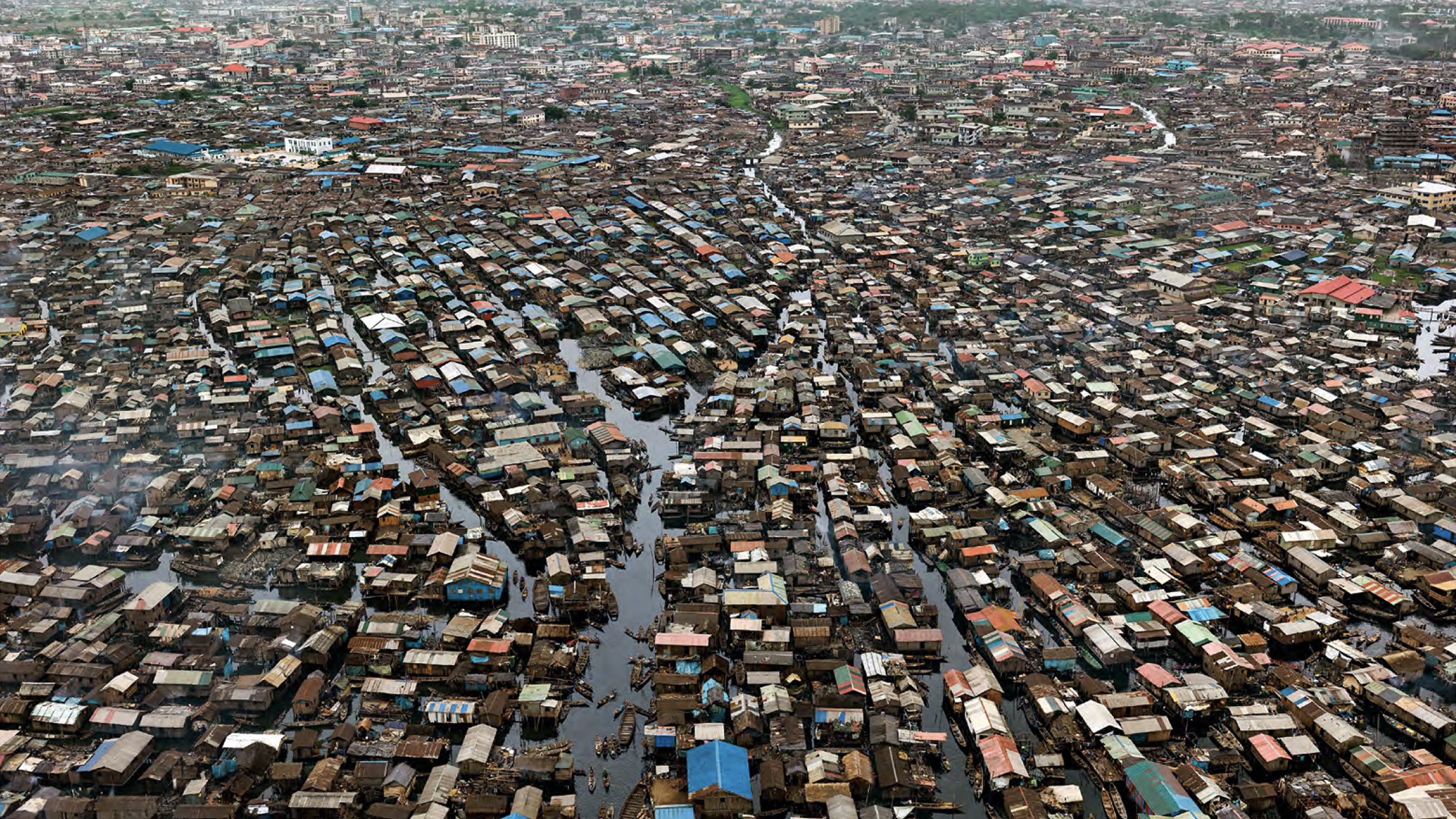
Another concept closely related to this framework, but with a more pronounced ecological emphasis, is the “toxic sublime.” Unlike the sublime experience felt in response to the grandeur of these human-made sites, it describes the experience of encountering landscapes of nature that have been polluted, poisoned, and industrially devastated. 3 As seen in Burtynsky’s Water and Salt and African Studies series on the third and fourth floors, this concept—often invoked when interpreting landscapes polluted by human activity, such as oil fields or mining waste—suggests that while the photographs may initially appear to aestheticize the landscape, they in fact produce an aesthetic-psychological response that evokes and prompts reflection on environmental destruction through the feelings of horror and threat they instill. When we look at a river polluted by oil smuggling in Nigeria, we are compelled not only to see a captivating landscape, but also to confront the environmental destruction that underlies it.
However, to make sense of the photographs on the second floor of the exhibition, produced through Burtynsky’s fieldwork in 2022 as he traveled over 3,000 kilometers across Türkiye’s Central Anatolia and Mediterranean regions, we need a different framework. While connected to the concepts mentioned above, this approach situates them within a broader context. Rather than focusing on massive industrial infrastructure or the environmental damage it leaves behind, these images instead highlight how humans intervene in the Earth—transforming it, at times disrupting it, and at others attempting to repair it. At this point, the concept of the Anthropocene, increasingly referenced in both scientific and cultural studies, comes into play as a framework that allows us to think about the issue at a broader scale. In its broadest sense, the Anthropocene describes a framework in which human activity shapes not only social and economic processes but also the planet’s geological and climatic systems on a determining scale. Discussions of the Anthropocene extend beyond the scientific domain and open up an aesthetic field of inquiry, raising the question of how humanity’s impact on the planet can be represented. This is because the effects of human activity on the Earth often do not operate at a scale that can be directly experienced. These effects tend to become visible through satellite imagery, aerial photographs, and large-scale landscape representations. In this context, the discourse on “Anthropocene visuality” has emerged as a concept that examines how the relationship between humans and the Earth is represented and made visible in works of art. 4
Landscapes of Türkiye from an Anthropocene Perspective
The photographs Burtynsky took in Türkiye offer particularly illuminating examples of how Anthropocene imagery operates. Captured from a distant, bird’s-eye perspective, these wide-angle panoramas make visible how human activity transforms the natural world through high-resolution landscape images. Photos of terraces built for erosion control, geometric agricultural patterns, and eroded sedimentary layers are not merely representations of destruction resulting from environmental degradation, but rather landscapes shaped through human intervention. For this reason, rather than reading these photographs solely through the overarching concepts of the “industrial” or the “toxic” sublime, it seems more meaningful to me to think of them within the framework of “Anthropocene visuality,” where the complex interaction between humans and the Earth becomes visible.
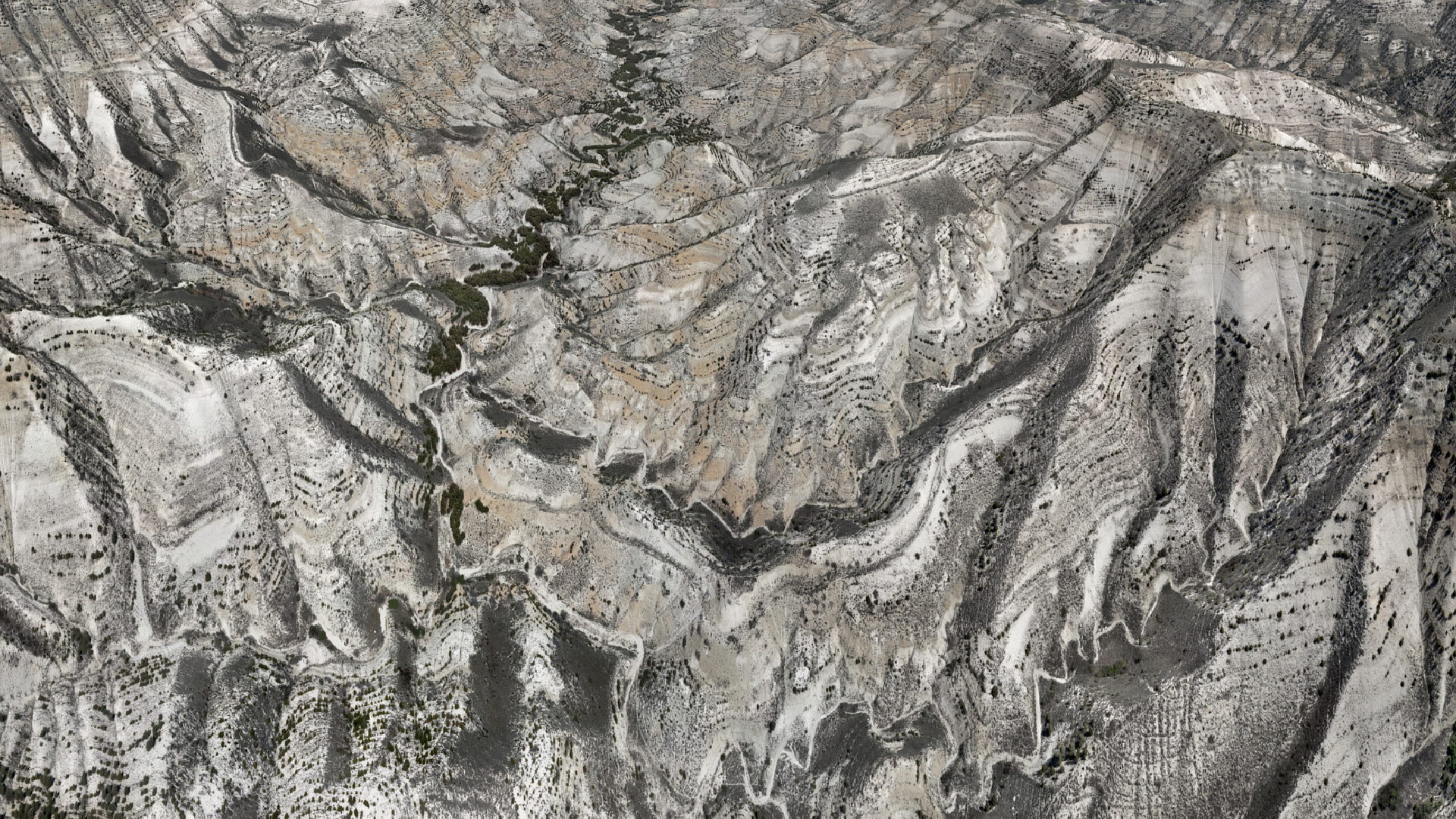
Edward Burtynsky, Erosion Control #11, Burdur, Türkiye, 2022
Courtesy of the artist and Flowers Gallery, London
One photograph from Burtynsky’s Erosion series that particularly stands out to me is this aerial view. At first glance, as the curator notes in the catalogue text, the landscape can almost be perceived as an abstract composition. As its context comes into focus, however, it becomes clear that this layered surface —where tones of light beige, gray, green, and orange intertwine— depicts a terraced terrain created for erosion control in Central Anatolia. The image simultaneously makes visible both traces of geological time and a new order shaped by human intervention. On closer inspection, we can also discern elements that allow us to grasp the scale of the composition: roads winding through the contours and trees planted at intervals to prevent landslides.
This image thus becomes a striking example of Anthropocene visuality, as it not only documents an eroded landscape but also makes visible humanity’s efforts to reshape the planet’s surface. What we encounter here is not simply the destruction of nature, but a record of the complex relationship between humans and the Earth. This intervention, undertaken to halt erosion, represents a technical response to an environmental crisis on the one hand, while on the other it also serves as a reminder that human activity now operates at a scale capable of reshaping the planet’s geological landscape.
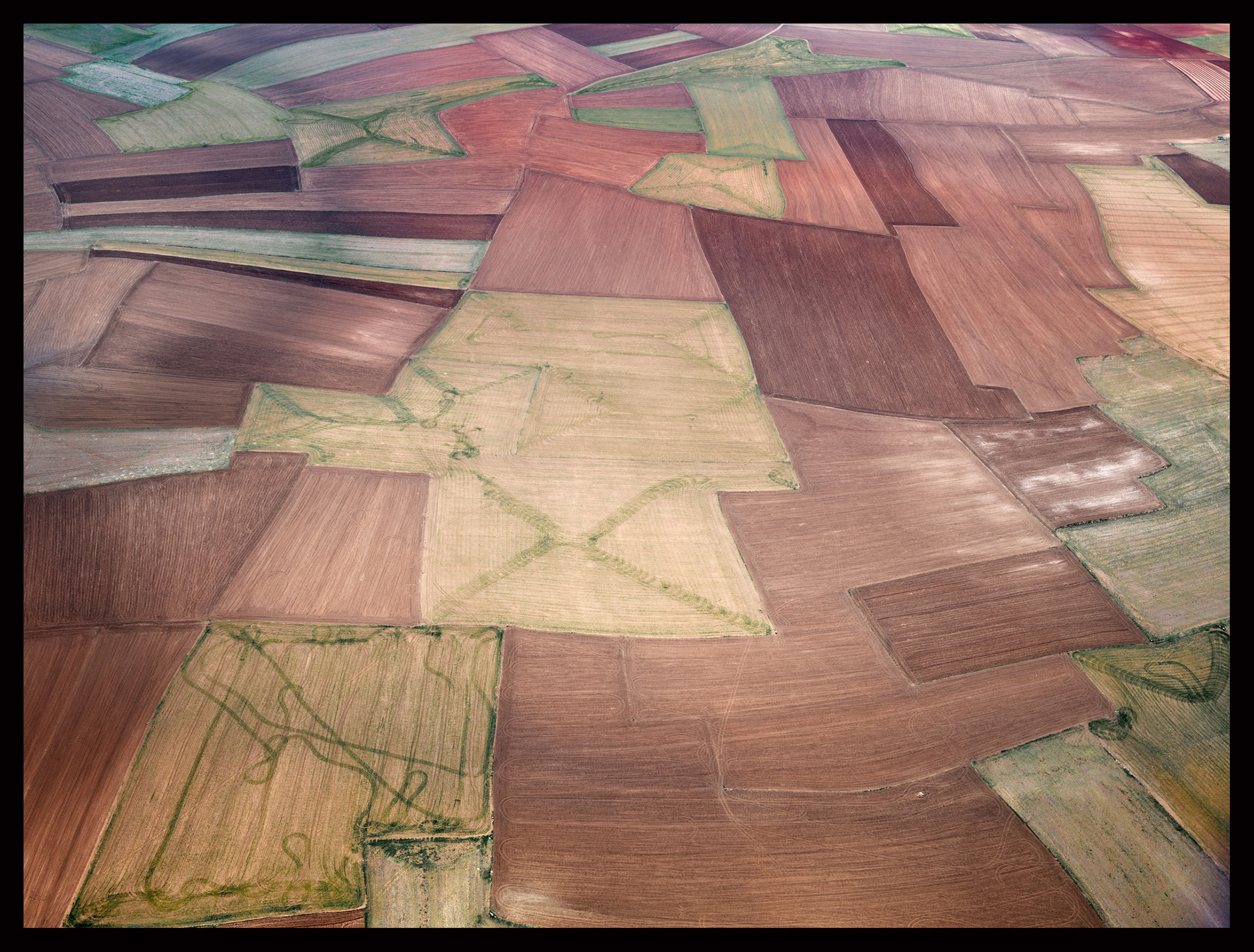
Edward Burtynsky, Farming #2, Kırşehir, Türkiye, 2022
Borusan Contemporary Art Collection
Another aerial photograph from Burtynsky’s Erosion series, included among the “Farming in Anatolia” examples, initially appears less as a traditional landscape than as an abstract composition of colorful geometric forms arranged side by side. As its context comes into focus, however, it becomes clear that the expansive surfaces in varying tones of light beige, brown, and green belong to cultivated fields across the Central Anatolian Plateau, planted with crops such as wheat, barley, sunflowers, and vegetables. As we come to understand this, we also begin to discern the fine lines marking the boundaries of each plot and the traces of tractor tracks. These irregular rectangular plots simultaneously make visible both the geometric order of modern agriculture and the ongoing effort to adapt to the land’s natural topography. Within the framework of Anthropocene visuality, this bird’s-eye perspective, constructed to nearly eliminate the human scale, leads us to perceive the photograph almost as a kind of cartographic surface. It prompts the recognition that humans are not merely users of the planet’s surface, but also agents who actively reshape it.
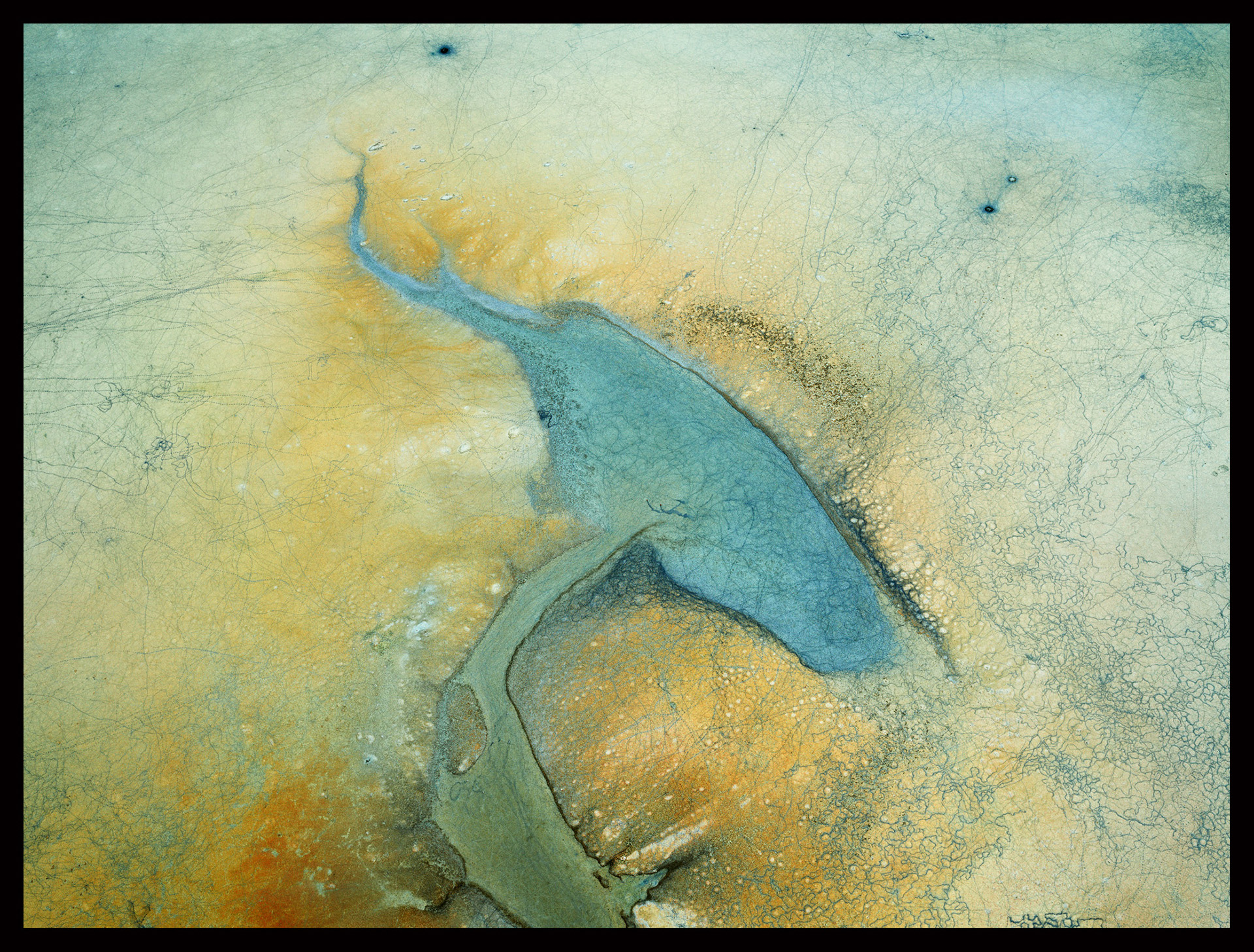
Edward Burtynsky, Salt Lakes #6, Bird Tracks, Lake Yarışlı, Burdur, Türkiye, 2022
Borusan Contemporary Art Collection
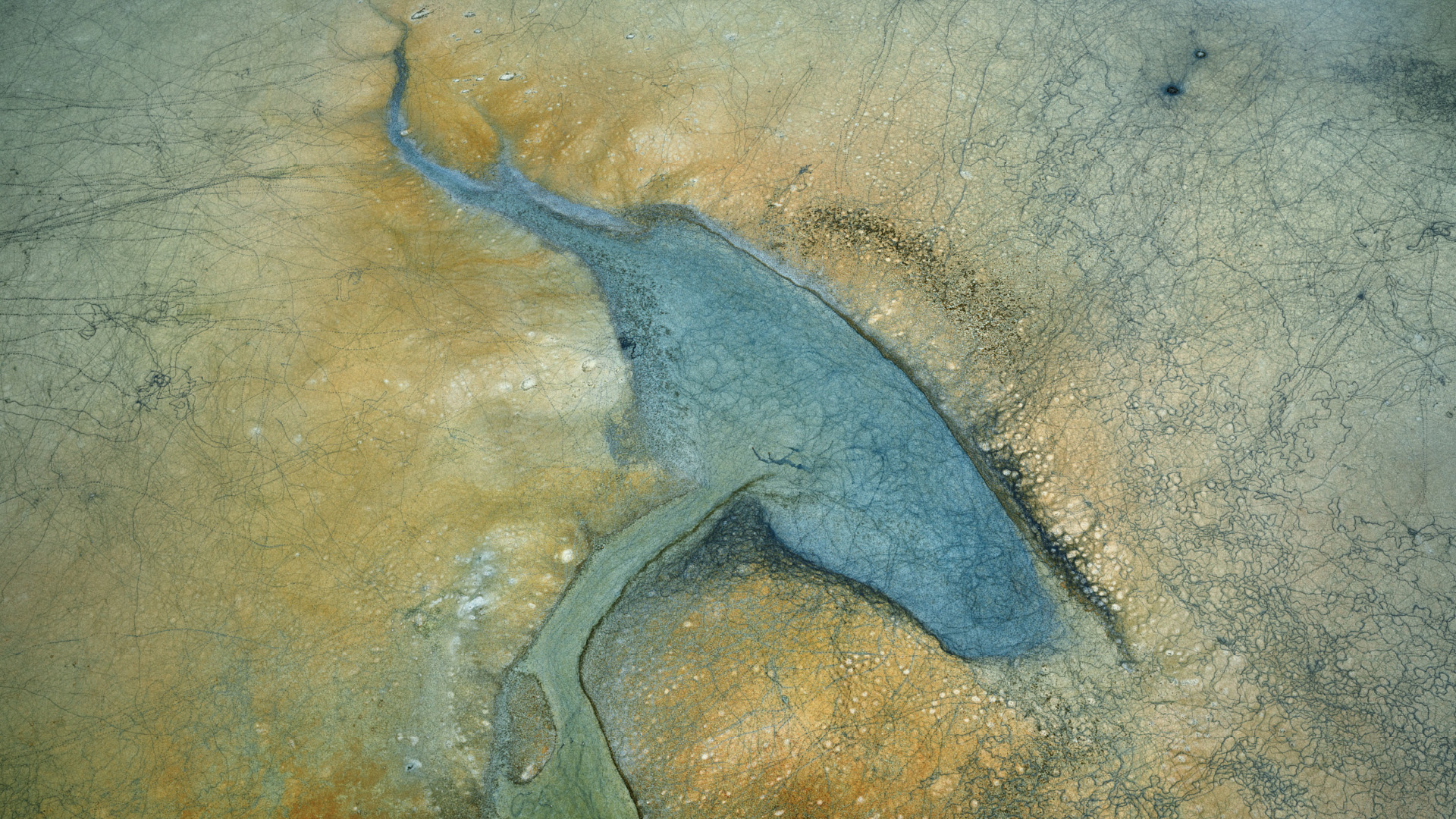
Another striking work from Burtynsky’s salt lake photographs under the theme Erosion is this photograph. What immediately draws the viewer in is its translucent texture, shimmering almost like a living surface. The mass, unfolding in shades of turquoise and deep blue, spreads organically across a vast expanse dominated by yellow, orange, and greenish hues. What truly makes the photograph captivating, however, is the network of fine lines dispersed across the surface surrounding the lake. At first glance, these lines resemble a vascular system, or even the growth patterns of a microscopic organism.
As the context of the photograph comes into focus, we come to understand that the image is formed by the tracks left by migratory birds moving across the shallow shores of Lake Yarışlı in Burdur. This area serves as a crucial stopover and feeding ground for numerous bird species migrating between Europe and Africa. The footprints left by the birds are periodically erased by seasonal changes in water levels and reappear during migration periods. The surface we see is therefore not simply an aesthetic pattern, but also a temporary record of the recurring ecological activity surrounding the lake.
This photograph by Burtynsky thus becomes another powerful example of how the visual language of the Anthropocene operates. At first glance, the surface appears to be shaped by nature’s own internal dynamics, yet it is in fact part of a fragile ecosystem formed through the indirect effects of human activity. Soil degradation, overgrazing, deforestation, and mining in the surrounding areas have increased sediment accumulation in the lake, leading to its gradual shallowing; at the same time, the artist’s elevated and distanced perspective allows these complex environmental processes to be read together on a single surface. The photograph thus moves beyond a romanticized view of landscape and becomes a narrative that carries the traces of the reciprocal interaction between humans and the Earth. From the perspective of Anthropocene visuality, this kind of image also serves as a reminder that transformations on the planet often unfold at a scale that cannot be directly observed and can only be grasped through such large-scale viewpoints. What we are witnessing here, therefore, is not simply a lake landscape, but a visual articulation of a new environmental reality emerging from the entanglement of human activity and natural systems.
Edward Burtynsky: Shifting Topography exhibition stands as a striking continuation of Borusan Contemporary’s long-standing approach to bringing international artistic production into dialogue with the local context. These three images, drawn from the 36 photographs the artist produced in Türkiye, are not simply documents of specific geographical landscapes, but visually compelling and thought-provoking traces of human activity on the Earth’s surface. For this reason, Burtynsky’s work helps us to recognize that in the Anthropocene era, the landscape can no longer be understood as merely “natural,” but has become a visual record of the complex relationship between humans and the Earth. Borusan Contemporary’s decision to support and present this creative process represents a significant cultural initiative, one that makes it possible to see the concrete manifestations of these globally debated environmental issues within the geography of Türkiye.
1- Marcus Schubert, “Burtynsky: Shifting Topography,” Edward Burtynsky: Shifting Topography exhibition catalogue, Istanbul: Borusan Contemporary, 2024, p. 13.
2- Edward Burtynsky: The Industrial Sublime, Frist Art Museum, Nashville,https://fristartmuseum.org/exhibition/edward-burtynsky-the-industrial-sublime/ (Access: 16.03.2026).
3- Jennifer Peeples, “Toxic Sublime: Imaging Contaminated Landscapes,” Environmental Communication, Vol. 5,Issue 4, December 2011, pp. 373–392.
4- Nicholas Mirzoeff, “Visualizing the Anthropocene,” Public Culture, Vol. 26, Issue 2 (73), April 2014, pp. 213–232.
ABOUT THE WRITER
Rumeysa Kiger is an art critic and researcher. She studied Philosophy at Boğaziçi University and completed her master’s degree in Cultural Management at Istanbul Bilgi University; she is currently pursuing her doctoral research in Art History at Istanbul Technical University. In 2018, she founded “Çok İyi İşler,” a digital art publication on Instagram that produces content on exhibitions and art events.
Share on

PREVIOUS BLOG
NEXT BLOG




Borusan Contemporary,
is a contemporary art, collection and education initiative of the Borusan Kocabıyık Foundation.
Personal Data Protection
Cookie Policy
© Borusan Contemporary, 2026.
is a contemporary art, collection and education initiative of the Borusan Kocabıyık Foundation.
Personal Data Protection
Cookie Policy
© Borusan Contemporary, 2026.
FOLLOW






BORUSAN CONTEMPORARY